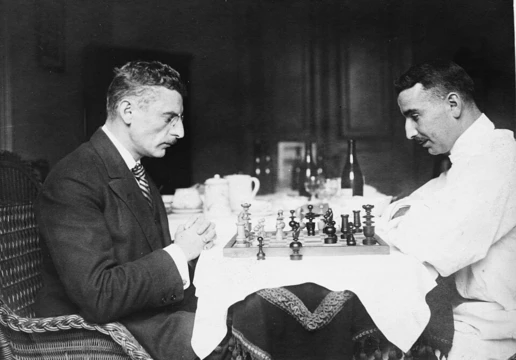
Strategy game
Games where decision-making skill determines the outcome.

A strategy game is a game in which players' uncoerced and often autonomous decision-making skills have a high significance in determining the outcome. Almost all strategy games require internal decision tree-style thinking and typically very high situational awareness. Strategy games are seen as a descendant of war games, but this definition is partial; they rely primarily on strategy, with complexity and game-scale actions as key factors.
- Classic strategy game
- Chess (originated in India, c. 6th century CE)
- Modern subgenres
- Abstract strategy, Eurogames, wargames, real-time strategy, turn-based strategy
Lore & Background
The history of turn-based strategy games goes back to ancient civilizations in Rome, Greece, Egypt, the Levant, and India. The Royal Game of Ur from c. One of the earliest strategy games still played is mancala; claims that artifacts from c. Chess, believed to have originated in India around the sixth century CE, spread westward by trade and gained strong social status, becoming a game of skill and tactics often forcing players to think two or three moves ahead.
Reader's Guide
Strategy games encompass a broad range of types, from abstract strategy games like chess and Go—which purists define as having no random elements or hidden information—to simulation games that attempt to model real-world decisions. Eurogames, or German-style boardgames, sit between abstract and simulation, emphasizing strategy, downplaying chance and conflict, and leaning toward economic themes. Wargames simulate military battles and can be strategic or tactical in military jargon; they are played with miniatures or on boards using hex maps. Strategy video games are categorized as real-time strategy (RTS) or turn-based strategy (TBS), often relying on artificial intelligence to emulate a thinking opponent. The concept of micro and macro scale helps describe gameplay, but the definition of strategy relies on the scale of actions within each game rather than the player's experience. The legacy of strategy games lies in their deep roots in ancient cultures and their evolution into diverse modern forms that continue to challenge decision-making skills.
Did You Know?
- Chess is believed to have originated in India around the sixth century CE.
Frequently Asked Questions
What defines a strategy game in card and tabletop gaming?
A strategy game is one in which players' independent, unforced decision-making carries the greatest weight in shaping the final result. These games typically demand tree-like logical planning and sharp awareness of the current board state.
Where did chess originate, and why is it considered a classic strategy game?
Chess traces its roots to India around the 6th century CE and is often cited as the archetypal strategy game because its outcome hinges almost entirely on the players' tactical and positional choices rather than luck.
What are the main modern subgenres of strategy games?
Today the category branches into abstract strategy, Eurogames, wargames, real-time strategy, and turn-based strategy. Each subgenre emphasizes different pacing or complexity levels, but all share the core requirement that deliberate planning drives the result.
How do strategy games relate to war games?
Strategy games are often viewed as a broader descendant of war games, but the relationship is only partial. While war games focus on military simulation, strategy games can span any domain and rely primarily on layered decision-making and large-scale game actions rather than combat mechanics alone.
More in Card & Tabletop Games 1-24
Elsewhere in the Card & Tabletop Games universe
Spotted an error? Know more?
This is a living reference — every entry is fact-audited, and reader corrections feed straight into our audit queue. Suggest an edit · See this site's audit record